Palm olein
Rich in oleic acid, with excellent oxidative stability.
- Cooking oil
- Salad oil
- Deep frying
- Margarine blends
- Snack food
Chemistry, properties and applications — from crude palm oil to olein, stearin and specialised fractions for food and non-food use.
Palm oil is an edible vegetable oil extracted from the mesocarp (flesh) of the oil palm (Elaeis guineensis). It is one of the world’s most widely used edible oils, with a value chain that runs from fresh fruit bunches through refining to RSPO-certified sustainable oil.
At SD Guthrie International Zwijndrecht, we process palm oil into fractions tailored to melting behaviour, stability and application needs.
Palm oil has a balanced mix of saturated and unsaturated fatty acids, which underpins its semi-solid character at room temperature and its broad processing versatility.
| Fatty acid | Code | Typical range | Type / note |
|---|---|---|---|
| Myristic acid | C14:0 | 0.5 – 1.5% | Saturated |
| Palmitic acid | C16:0 | 40 – 45% | Saturated — increases hardness |
| Stearic acid | C18:0 | 4 – 5% | Saturated |
| Oleic acid | C18:1 | 38 – 44% | Monounsaturated — improves stability |
| Linoleic acid | C18:2 | 8 – 11% | Polyunsaturated |
Crude palm oil is refined to RBD palm oil, then separated into liquid and solid portions through controlled cooling and filtration. Further fractionation produces specialised grades with different saturation levels and melting behaviour.
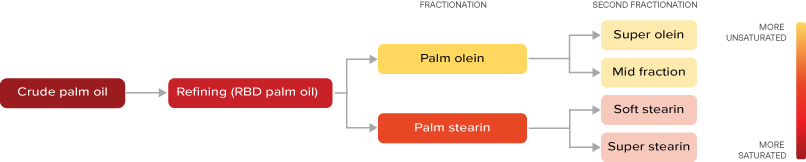
More unsaturated fractions stay liquid; more saturated fractions solidify — that is why oleic- and linoleic-rich cuts remain pourable while palmitic-rich cuts harden.
Each fraction serves different formulation needs — from clear frying oils to hardstocks for margarine and confectionery.
Rich in oleic acid, with excellent oxidative stability.
Semi-solid to solid, higher palmitic acid, high solid fat content (SFC).
Very clear liquid, higher oleic acid, lower cloud point, excellent cold stability.
Rich in symmetrical triglycerides (POP, POS), with excellent crystallisation and melting behaviour.
Second fraction from palm stearin — semi-solid with moderate palmitic acid and moderate SFC.
Most saturated fraction — very hard and brittle at room temperature, with very high SFC.
Typical property ranges help match the right fraction to your process and product.
| Property | Palm oil | Palm olein | Palm stearin | Super olein | Mid fraction | Soft stearin | Super stearin |
|---|---|---|---|---|---|---|---|
| Physical state | Semi-solid | Liquid | Solid | Liquid | Semi-solid | Semi-solid | Solid (hard) |
| Melting point (°C) | 33 – 39 | 18 – 24 | 44 – 56 | 15 – 20 | 32 – 37 | 47 – 53 | 55 – 60 |
| Saturated fat | Medium | Lower | Higher | Lowest | High | Higher | Highest |
| Iodine value | 50 – 55 | 56 – 60 | 28 – 40 | 60 – 70 | 40 – 46 | 38 – 42 | 10 – 16 |
| Oxidative stability | High | High | Very high | High | High | Very high | Very high |
| Main uses | General purpose | Cooking and frying | Bakery | Frying | Chocolate confectionery | Margarine, shortening | Hardstocks |
Typical quality targets for refined palm oil (indicative):
Not all palm oil is created equal. Download the full leaflet, or contact us to align on specifications, documentation and timelines.
This website uses essential cookies to enable core site functionality. As we respect your privacy rights, you have the option to choose whether or not to allow certain types of cookies. Analytics cookies are used to track website usage. We do not use advertising or functional cookies. You can control your cookie settings at any time or accept the standard features. You can close this banner to continue with only essential cookies.
For more information on the cookies, please visit our Privacy Statement here.